Public Policy Southampton shares pensions expertise with DWP
Public Policy Southampton recently organised an Areas of Research Interest (ARI) Workshop with the Department of Work and Pensions (DWP). This significant collaboration between the University and the DWP brought together academics from across the University. It included talks from DWP delegates and University of Southampton academics on topics such as Pensions and Later Life, Health and AI, Creative Methods, Working Age Modelling, and Government Statistics. The day fostered connections and collaborations moving forward, with DWP colleagues and University researchers keen to explore solutions to key policy challenges.
The event began with a welcome from Professor Jane Falkingham, Vice-President (Engagement and International), who showcased Southampton’s leading research across Health Sciences, Social Policy, Demography, Creative Industries, and broader Social Sciences, all directly relevant to DWP’s areas of interest. Professor Falkingham also shared exciting news about the University’s growth, including our newly opened Delhi campus where Social Sciences has the distinction of being one of the first disciplines established.

Mike Jones, DWP Deputy Chief Scientific Adviser, provided key insights into the Government’s ARI initiative. ARI’s summarise the key research questions facing government departments – but are not solely limited to government organisations. The DWP will be publishing its fourth ARI later this year. PhD student Cindy Brooks, who is currently undertaking a social research secondment with DWP, complemented this by providing an overview of her experience to delegates. Cindy is a social impact Research Fellow at Southampton; her secondment situated in the DWP’s in house research hub – the Central Analysis and Science Strategy (CASS) Unit. The CASS unit provides the latest research to the DWP, ensuring the department has access to this but also fosters relationships between the DWP and academic institutions including Southampton. Cindy’s experience specifically has involved leading and contributing to innovative research projects, presenting seminars as part of the Journal Club series, conducting in depth analyses and delivering methodological seminars, shadowing civil service colleagues for research policy projects, and brokering the relationships between the DWP and Southampton colleagues.
The first Spotlight Session, on Pensions and Later Life, was led by colleagues from the University’s Centre for Population Change.
- Professor Athina Vlachantoni, Professor of Gerontology and Social Policy, highlighted evidence on pension protection and inequalities in later life.
- Professor Maria Evandrou, Professor of Gerontology, explored the interplay between work–life balance, caring responsibilities in mid-life, and financial wellbeing in retirement.
- Professor Traute Meyer, Professor of Social Policy, discussed current and emerging challenges in pension reform and social policy design.
The second Spotlight Session, on Work, Health and AI, brought together experts from the Work Futures Research Centre and Health Workforce Systems.
- Dr Jane Parry, Associate Professor of Work and Employment and UK Parliament Thematic Research Lead on Business, Economics and Trade, presented findings on flexible and hybrid working and their implications for the future of employment.
- Dr Christina Saville, Lecturer in Healthcare Management, shared insights from her research on organisational structures and staffing in the health sector, focusing on workforce pressures and nursing workloads.
- Dr Rebecca Taylor, Associate Professor in the Department of Sociology, Social Policy & Criminology, presented research on digital skills gaps and professional practice, and the regulatory implications of digital and AI-augmented work environments
- Dr Joe Atkinson, Associate Professor in Employment law, drew upon his research at the intersection of employment and labour law, human rights law, and the regulation of emerging workplace technologies, especially algorithmic management and the evolving relationship between artificial intelligence and employment law.
The third spotlight session on Methods, included contributions from academics and DWP colleagues, including Dave Pankhurst, Head of Working Age Modelling at DWP, who presented on Working Age Modelling and Forecasting, outlining current approaches to data-driven policy simulation and prediction. University colleagues presented on the following topics:
Professor Paul Smith discussed Government Statistics, giving an overview of the Government Statistics MSc at the University, emphasising the importance of methodological rigour, data linkage, and transparency in evidence-based policy.
Professor Christine Currie, representing CORMSIS (Centre for Operational Research, Management Science and Information Systems), introduced the Centre’s interdisciplinary work on advanced modelling, optimisation, and decision analytics.
Professor Dan Ashton presented on Creative Methods, illustrating how arts and humanities methodologies can offer novel insights into lived experience, public engagement, and policy communication.
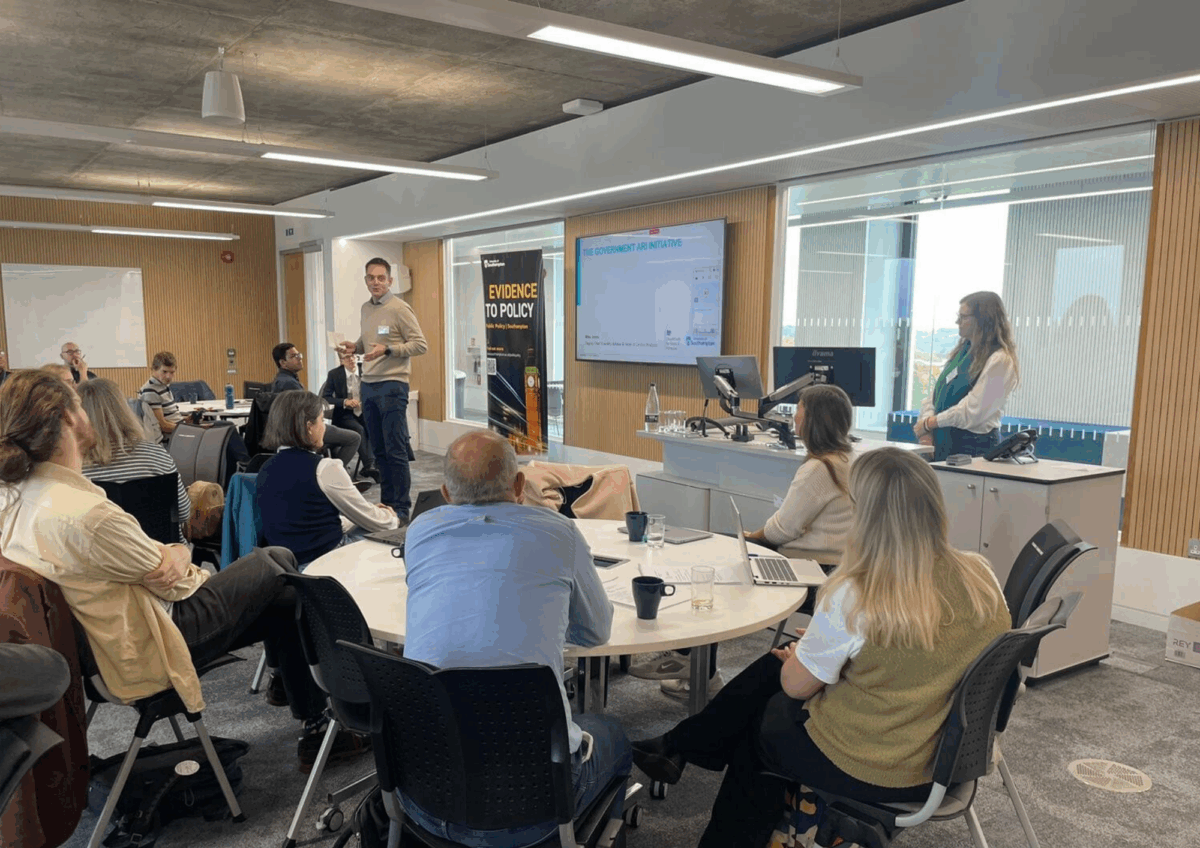
The day culminated in productive breakout sessions, with academics given the opportunity to discuss topics outlined above with DWP policy makers and colleagues. These topics included Labour Markets and Work, Health & Disabilities, bringing academics from disciplines across the University together with DWP colleagues to foster future connections and potential for collaborations and knowledge exchange.
If you are a Southampton researcher wanting to engage more in Public Policy related events or opportunities, please contact Public Policy Southampton at publicpolicy@soton.ac.uk