A month in the life of the University’s Centre for Population Change
Members of the University’s Centre for Population Change and Connecting Generations (CPC-CG), funded by the Economic and Social Research Council, have spent the autumn meeting policymakers and stakeholders across Europe and the UK, using current research, shared learning and practical collaboration to shape debate on ageing, labour markets, fertility and social care. These activities, led by the Centre’s Director Professor Jane Falkingham CBE (VP Engagement and International), show how the team is building strong links between its academic work, policy engagement and wider partnerships, helping to turn insight into action and support the University’s long-term aims. Below we report on just some of their recent engagements.
Expert meeting with EU Commissioner Dubravka Šuica
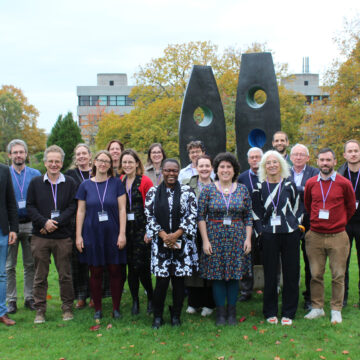
Professor Jane Falkingham and Professor Jakub Bijak met with the European Commissioner Dubravka Šuica and European Commission officials, along with a group of distinguished population researchers from across Europe, to discuss policy priorities for an upcoming demographic agenda.
In her opening remarks, the Commissioner highlighted the European Union’s main political aims on demographic change. Longer lives are now common, yet low fertility rates are shrinking the working-age population. She noted that this shift threatens efforts to strengthen Europe’s competitiveness while keeping its social model sustainable. With this in mind, the experts at the meeting considered how the EU might respond through affordable housing, poverty reduction, intergenerational fairness, skills development, and women’s empowerment. The group stressed the limits of fertility-centred approaches and pro-natalist policies, the need to avoid narrow age-based thinking, and the growing importance of high-quality healthcare systems. Migration, regional variation, more robust data, and communication and education were also key themes

Further developing its 2023 ‘Demography Toolbox‘ of possible policy options, the Commission intends to use the experts’ contributions to create policy strategies and roadmaps, update its Atlas of Demography, and publish a new Demography Report in 2026.
Building a resilient future for Europe
Jakub’s contribution to the meeting with the EU Commissioner was informed by his work with Dr Emily Barker on the FutuRes project.
Since early 2023, the FutuRes project (Towards a Resilient Future of Europe), funded by the European Union’s Horizon Research and Innovation Programme, has been bringing scientists and policymakers together to address challenging societal situations. Jakub and Emily represent the University of Southampton as part of an international project team that has been examining what makes people and society resilient, and how resilience can be applied to the challenges posed by demographic change, specifically those posed by labour markets, health care, social security programmes and intergenerational fairness.
To address labour force challenges, Jakub and Emily’s contribution examined the extent to which job automation (including robots and AI algorithms) and immigration can work in combination with other strategies. Their modelling showed that immigration and automation can help to ease short-term labour pressures, yet long-term resilience requires wider investment in domestic labour forces. Their findings feed into recommendations on how Europe can respond as older age groups expand and younger cohorts contract.
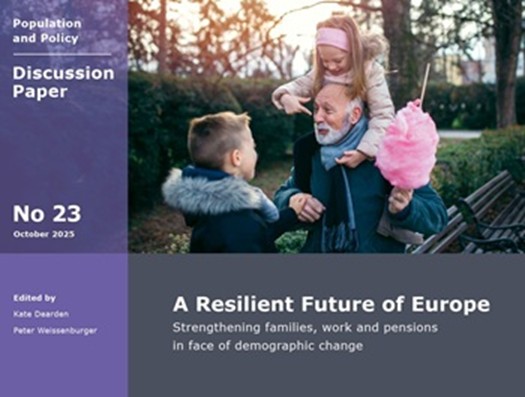
Their key messages and subsequent recommendations are presented in the project’s final discussion paper: A resilient future of Europe: Strengthening families, work and pensions in the face of demographic change
The future of ageing and care
A parallel European high-level expert workshop on ageing and care, organised by Age-It and CPC-CG partners Population Europe, brought together researchers and practitioners to consider the growing complexity of care needs among older adults, innovations in care delivery, and strategies for creating sustainable, inclusive systems supported by technology.
Professor Athina Vlachantoni contributed insights from CPC-CG research on cohort differences in caring patterns in the UK, highlighting how generational shifts are shaping both the demand for and provision of care.
Reflecting on the workshop, she said: “Thank you to Population Europe for inviting me to be part of a panel of experts discussing sustainable, person-centred and tech-enabled ageing, and give a summary of our CPC-CG work on cohort differences in caring patterns. Such focused meetings offering opportunities for academics and policy stakeholders to exchange views on critical policy issues can go a long way with sharing state-of-the-art research findings across Europe and considering policy solutions. I found the meeting particularly useful given the current policy debate in the UK on funding social care.”
Pension protection and pension reform
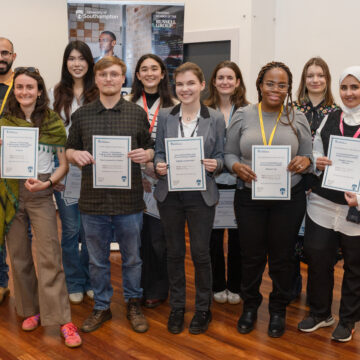
Back in the UK, the team led further engagement, this time on pension protection and saving among minority ethnic communities. Athina led a dissemination workshop for her ESRC-funded ‘Promoting inclusivity in pension protection and other forms of saving among men and women from black and minority ethnic communities in the UK’ project. The event brought together colleagues from Southampton City Council, the Pensions Policy Institute, Age UK, Daniela Silcock Pensions Research, with research participants / co-producers.
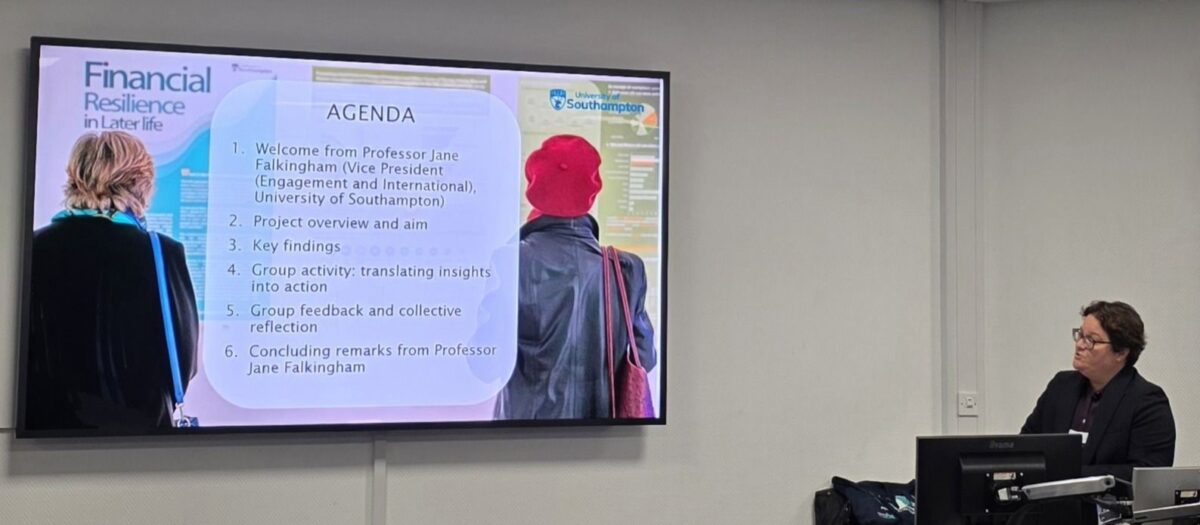
Discussions centred on the findings from the project, whose aim was to inform national debate on pension reform by improving the inclusivity of individuals from minority ethnic communities in pension policy planning, and understanding the socio-economic factors affecting pension protection among current and future generations.
To place individuals from minority ethnic groups in the UK at the heart of the research, the project team used participants local to Southampton. They compiled real-life narratives, using innovative methods such as photo images taken by participants to describe what late-life financial planning means to them, as well as engaging younger people through schools outreach activities on financial planning.
Professor Jane Falkingham opened the meeting and drew links between the research project and the University’s important civic work in Southampton. During the meeting, stakeholders and research participants stressed the value of intersectional research, inclusive recruitment and pension design, better financial education across the life course, and the influence of community leaders.

Athina, with project team colleagues Professor Yuanyuan Yin (WSA) and Dr Spela Mocnik, was also recently invited to the Department for Work and Pensions to share the project’s research findings.
For further project information, watch Spela deliver a CPC-CG/CRA webinar on ‘Lenses on later life: Exploring financial planning and resilience through participatory and design-led research’.
Declining number of children in London
The London Assembly, a 25-member elected body responsible for representing the interests of Londoners and holding the Mayor of London to account, also called on CPC-CG expertise. Drawing on her work on the UK Generations and Gender Survey project, Dr Bernice Kuang gave evidence to the Assembly’s Economy, Culture and Skills Committee on the causes of the declining number of children in London.
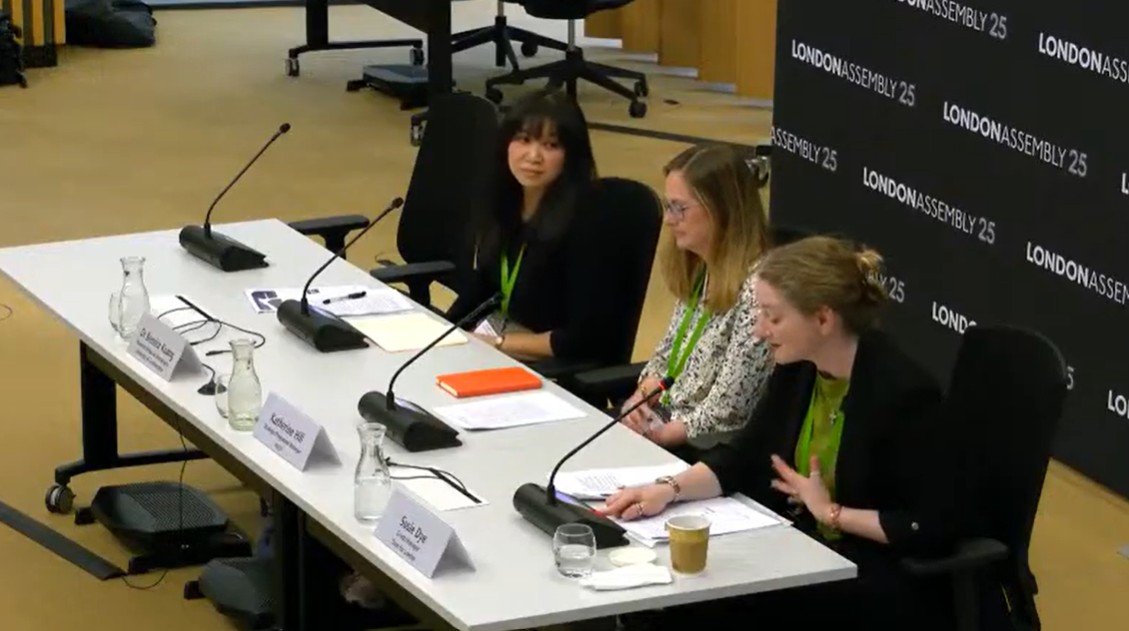
The meeting brought together experts to provide insights into the long-term impact a reduction in young people will have on London’s schools, businesses and wider economy. During the meeting, Bernice was called upon to discuss reasons for the national decline in fertility rates, and the reasons behind them, considering how the unique composition of London might vary from the national trend, and the impacts of domestic and international migration. She discussed people postponing the age they have children, economic insecurity, housing pressures and the limited reach of childcare support, noting that costs in the capital are particularly high. She also highlighted how migration flows shape London’s population structure and future workforce.
In addition to contributing to the meeting, Bernice submitted written evidence to the Committee in response to their call for evidence. Watch the full meeting.
The importance of data infrastructure
The Office for National Statistics (ONS) recently hosted a special event to mark the Census 2021 linkage to the ONS Longitudinal Study, bringing together staff from UK Government departments, national statistical offices, the Longitudinal Study (LS) user support teams, and LS users.
Professor Ann Berrington discussed the unique ability of these census-linked administrative data to provide a detailed understanding of recent fertility trends and support robust projections. She also described findings from the ‘Understanding and projecting fertility trends‘ project, noting the challenges of accessing census-linked administrative data from the different trusted research environments at the Office for National Statistics, National Records for Scotland and the Northern Ireland Statistics and Research Agency.
The programme featured talks on topics ranging from migrant health and geography to social mobility and data access, highlighting the breadth of research made possible through the UK’s longitudinal study infrastructure. The day also included keynote addresses from a representative of the National Statistician and from Professor Alison Park, ESRC Deputy Executive Chair, who emphasised the importance of the UK’s census-linked longitudinal studies for evidence-based policy and social research.
Across each event, the Centre’s members used their state-of-the-art research findings to inform active policy conversations and strengthen the University’s ties with organisations working on some of the most significant demographic challenges facing the UK and Europe.
Read the full stories and access related publications on the CPC-CG website. To get the latest on CPC-CG activities and news, subscribe to the newsletter magazine ‘Changing Populations’ and follow the Centre on social media.
Share this article to social media: