Working from Home not yet bridging UK regional divides
Research led by Professor Jackie Wahba OBE of the ESRC Centre for Population Change and Connecting Generations (CPC-CG), in collaboration with leading UK universities, has found that the rise in working from home (WFH) since the Covid-19 pandemic has not delivered the expected boost to struggling UK regions. The findings, cited in a new House of Lords Select Committee report, challenge the belief that remote work would help spread high-skilled jobs and talent more evenly across the country.
The independent research, funded by the Ministry of Housing, Communities and Local Government through a grant to the Economic and Social Research Council, analysed national data from the UK Household Longitudinal Study and Labour Force Survey. The team also conducted interviews with stakeholders from local and regional government, businesses, and universities in cities including Glasgow, Sheffield, and Birmingham. They discovered that while WFH is now common among high-skilled professionals, especially in and around London, most continue to live near major employment hubs and follow hybrid work patterns. They also found that when high-skilled workers change where they live, housing needs tend to be the driver, rather than jobs.
“Working from home is now a normal part of working life, with the potential to change where and how people work,” said Professor Jackie Wahba. “But so far, it remains most common among higher earners in a few sectors, mostly near London and other major cities. The idea that remote work would allow lagging regions to attract high earners has yet to materialise, and may not be realised at all.”
The research highlights both opportunities and challenges. Employers and local leaders noted benefits such as wider recruitment and more efficient office use, but also raised concerns about quieter city centres, weaker workplace culture, and the limited ability to work from home in many sectors. The study warns that without stronger policy action, WFH could even deepen regional divides.
Key recommendations include investing in transport, broadband, schools, healthcare, green spaces, and affordable housing, alongside flexible work options, to attract and retain talent. The report also calls for better national and local data on WFH patterns and more research on employer perspectives.
The increased flexibility of remote and hybrid working can be especially beneficial to people with disabilities, parents, and carers, potentially helping more people return to work. However, flexibility alone will not solve regional inequalities without broader policy support.
Find out more in the CPC-CG Policy Briefing Working from home and regional disparities: Insights for UK policy.
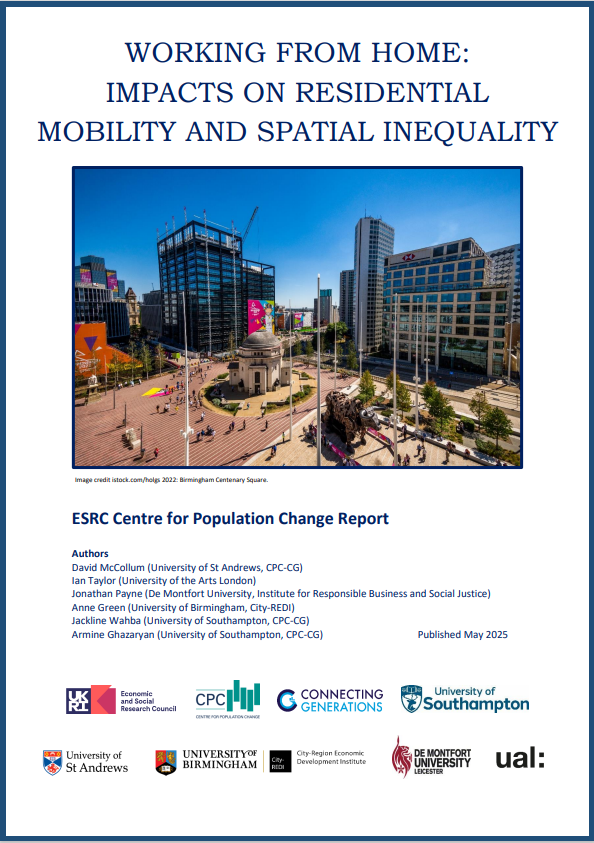
Read the full report Working from home: Impacts on residential mobility and spatial inequality.
Share this article to social media: