SMMI leads call for urgent shift towards a sustainable ‘blue’ ocean economy
Drawing on the breadth of knowledge in the Southampton Marine & Maritime Institute (SMMI), Susan Gourvenec, Professor of Offshore Geotechnical Engineering and Deputy Director of the SMMI, alongside SMMI Policy Research Fellow Dr Wassim Dbouk, Professor of Archaeology and SMMI Director, Fraser Sturt and Professor of Geochemistry and past SMMI Director, Damon Teagle have published a new research paper which highlights the urgent need to rethink how the world uses and relies on the ocean.
Susan Gourvenec believes the diverse expertise of the team across disciplines to be one of its key strengths in delivering impactful research.

Susan says: “With roots in engineering, law, archaeology, and the natural sciences, our team brings a richness of expertise and diverse methodological perspectives to the table, and we are comfortable questioning each other. That’s what empowers us to tackle complex challenges from multiple angles, and foster innovative, integrated solutions to systemic problems.”
Highlighting the interdisciplinary nature of the research in the paper and his role in producing it, Fraser says:
“As Director of the SMMI, my role is to help bring researchers together to address complex interdisciplinary challenges. This project drew on my understanding of oceans and the scholarships that surround them from a humanities perspective, completing that found in engineering, law, politics and ocean and earth science.”
Titled Pathways to a Blue Economy, the paper warns that the current ‘grey’ model of ocean usage continues to threaten fragile marine ecosystems and global climate stability. The authors outline alternative futures for the ocean economy: business-as-usual, probable, and ‘blue’. Only the latter can support both a thriving ocean and a stable climate for future generations.
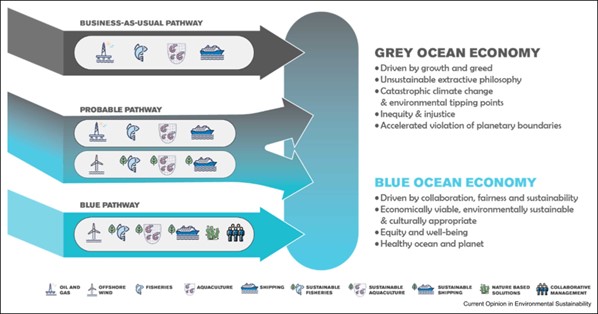
Transitioning to a blue economy requires a rapid increase in renewable energy, a steep decline in hydrocarbon production, improvement in sustainability of fishing and shipping, and decreased waste from land-based agriculture and coastal cities – all supported by policy that encourages more sustainable practices.
As the SMMI team notes in the paper, inaction poses high risks: the current pace of energy transition won’t meet mid-century decarbonisation and sustainability targets; over 70% of offshore energy is still expected to be supplied from fossil fuels by 2050; the International Maritime Organization’s targets to reduce shipping emissions have faced delays due to slow technological progress and adoption, and while seafood production will rise through aquaculture as climate change, overfishing and illegal, unregulated and unreported fishing reduce potential for wild catch, forecasted harvests still exceed sustainable limits.
Yet, Professor Gourvenec and the team remain optimistic, highlighting that proactive leadership efforts can still deliver a sustainable ocean future. The authors say in the report:
“Shifting our grey ocean economy to one that is economically viable, environmentally sustainable, culturally appropriate and focused on social equity and well-being is challenging. It requires ambitious proactive strategies and decisions now, which will ultimately protect the health of the oceans on which the ocean economy and humanity depend.”
Drawing on first-hand experience engaging with international ocean dialogues and climate negotiations, Dr Wassim Dbouk explains the systemic and institutional barriers to creating lasting impact:

“The transition to a blue ocean economy must rest on pragmatic, equitable and just cooperation between organisations and their governments, to ensure that solutions are not only environmentally sound, but also fair, inclusive, and built on genuine international partnership.”
The study builds on SMMI’s earlier report From grey to blue: an ocean economy fit for the future, which was commissioned to inform the UK Ministry of Defence’s Global Strategic Trends: Out to 2055 (GST 7) publication, recognising the central role ocean health will play in global prosperity, security, and health.
Read the open-access paper to explore how today’s decisions can secure a sustainable and just blue ocean future, and check out The Conversation article for a 5-step plan and case studies from around the world demonstrating that the transition to a blue economy is within our control
Visit the SMMI SharePoint site to learn more about the latest marine and maritime research at the University.
Share this article to social media: