UoS academics contribute to National Cancer Plan, supported by Public Policy|Southampton
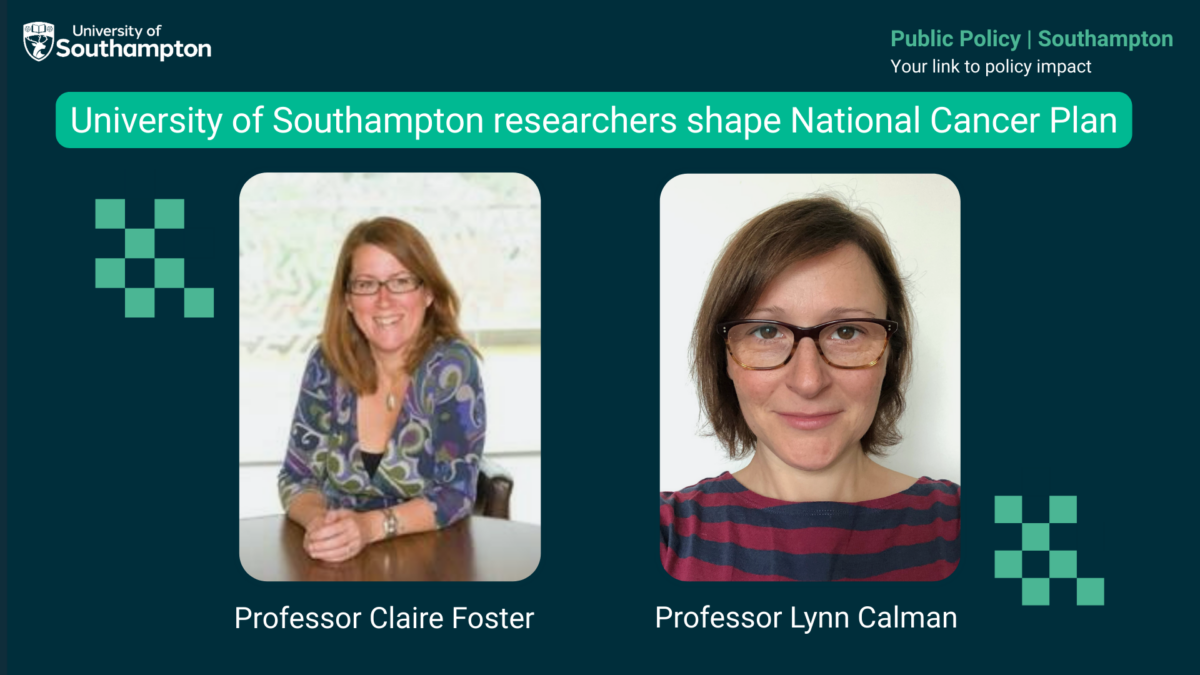
Academics from our University have played a pivotal role in shaping the UK’s new National Cancer Plan, supported by the University’s Public Policy|Southampton team. Through sustained, research-informed engagement with Parliamentary committees, expert panels and government consultations, Professors Claire Foster and Lynn Calman, along with colleagues from the Centre for Psychosocial Research in Cancer (CentRIC+) have ensured that evidence from Southampton directly informed national cancer policy.
Their contributions, spanning digital decision support, personalised psychosocial care, improved clinical communication and integrated care across primary and secondary services, have culminated in invitations to high-level UK and EU roundtables and direct input into the Department of Health and Social Care’s landmark strategy. This impact demonstrates Southampton’s growing influence in translating world-leading cancer research into meaningful national policy change.
Professor Foster and Professor Calman summarise below their experiences of engaging with policy with PPS support:
“It’s been great to see the real-world impact of our research supported by PPS over the years. From small beginnings, and various smaller collaborations over the years, we’ve developed long-term relationships that have evolved into something truly significant, as seen in our contributions to the National Cancer Plan. It really demonstrates the value of the PPS team’s responsiveness. When we needed to identify policy implications of our research findings, we came to them and they turned it into something real and impactful. The training sessions and workshops have also been particularly valuable. Academics are trained to communicate in a particular way that isn’t always compatible with the policy world, so having opportunities to upskill, to tailor how you communicate and identify who you need to speak to, makes a real difference. The Policy Associates are especially helpful in translating academic work into policy-friendly communications, and together with PPS, they’ve enabled us to sit in positions of influence.’
The pair provided evidence-based recommendations across the cancer care pathway, emphasising the need for digital decision support tools for genetic testing, improved communication skills training to prevent overtreatment (particularly in prostate cancer), and a transformation of personalised care from tick-box exercises into meaningful and supportive conversations soon after cancer diagnosis, then during treatment and into survivorship. They highlight the Cancer Nursing Across Boundaries model, which proved cost-neutral while improving patient outcomes and reducing GP/ED attendance, and advocate for enhanced Holistic Needs Assessments that include mental health and self-efficacy measures, targeted support for underserved populations, and faster implementation of evidence-based interventions into routine NHS care.
Professors Foster and Calman have made multiple evidence submissions, including to the Health and Social Care Committee on Cancer Services (2021), a Parliamentary Expert Panel (2022), and the 10-year Cancer Strategy Plan call for evidence (2025). Following this, Professor Foster was invited to a European Union roundtable on breast cancer. As a result, she had the opportunity to develop a brief setting out key recommendations with broader applicability beyond breast cancer, including the emphasis of personalised care, through comprehensive needs assessments and digital tools. Professor Calman was herself a member of the Living With and Beyond Cancer External Reference Group for the National Cancer Plan, and her research and education portfolio focuses on personalised psychosocial care and support for people living with and beyond cancer.
This sustained engagement culminated in December 2025, when the Department of Health and Social Care invited Professor Foster to join a roundtable session to inform the National Cancer Plan. This provided a significant opportunity to help shape one of the government’s most important health policy initiatives. The Plan, announced in February, sets out the Government’s long-term ambitions for improving cancer prevention, diagnosis, treatment and survivorship care across England. Professor Foster has also recently contributed to an article in The Independent on mental health in cancer patients, drawing upon her research and calling for early mental health screening and assessment after cancer diagnosis so that people receive the right support at the right time.
Read the academics team’s reaction to the recent publication of the UK government’s 10-year National Cancer Plan here: Southampton researchers react to new National Cancer Plan
If you are an academic wanting to maximise the policy impact of your work, please get in touch via publicpolicy@soton.ac.uk or sign up to their membership.
Share this article on social media: